
Super Intelligence Governance:
QuSmart.AI vs. Microsoft, Amazon & Google
To claim Super Intelligence Governance, a solution must govern Super Intelligence itself, not just monitor autonomous agents and swarms.
QuSmart.AI Agent Governance Solutions are the only Super Intelligence Governance standard that passes all three requirements. Microsoft, Amazon, and Google agent governance stacks do not.
The 3-Question Test
If the answer to any one of these questions is NO, the solution cannot deliver defensible oversight or withstand regulatory, board, audit, or congressional scrutiny.
- Does it govern Super Intelligence itself?
- Can it govern your agents, your vendors' agents, and adversarial agents?
- Can it immediately stop autonomous agents and swarms from executing when you decide they must stop?
Three questions. Three essential requirements. No exceptions.
3-Question Scorecard
QuSmart.AI passes all three. Microsoft, Amazon, and Google pass none.
| Question | QuSmart.AI | Microsoft | Amazon | |
|---|---|---|---|---|
| Governs Super Intelligence itself | YES | NO | NO | NO |
| Governs your agents, vendors' agents, and adversarial agents | YES | NO | NO | NO |
| Stops autonomous agents and swarms on human command | YES | NO | NO | NO |
Swipe to pan · Tap to open full size
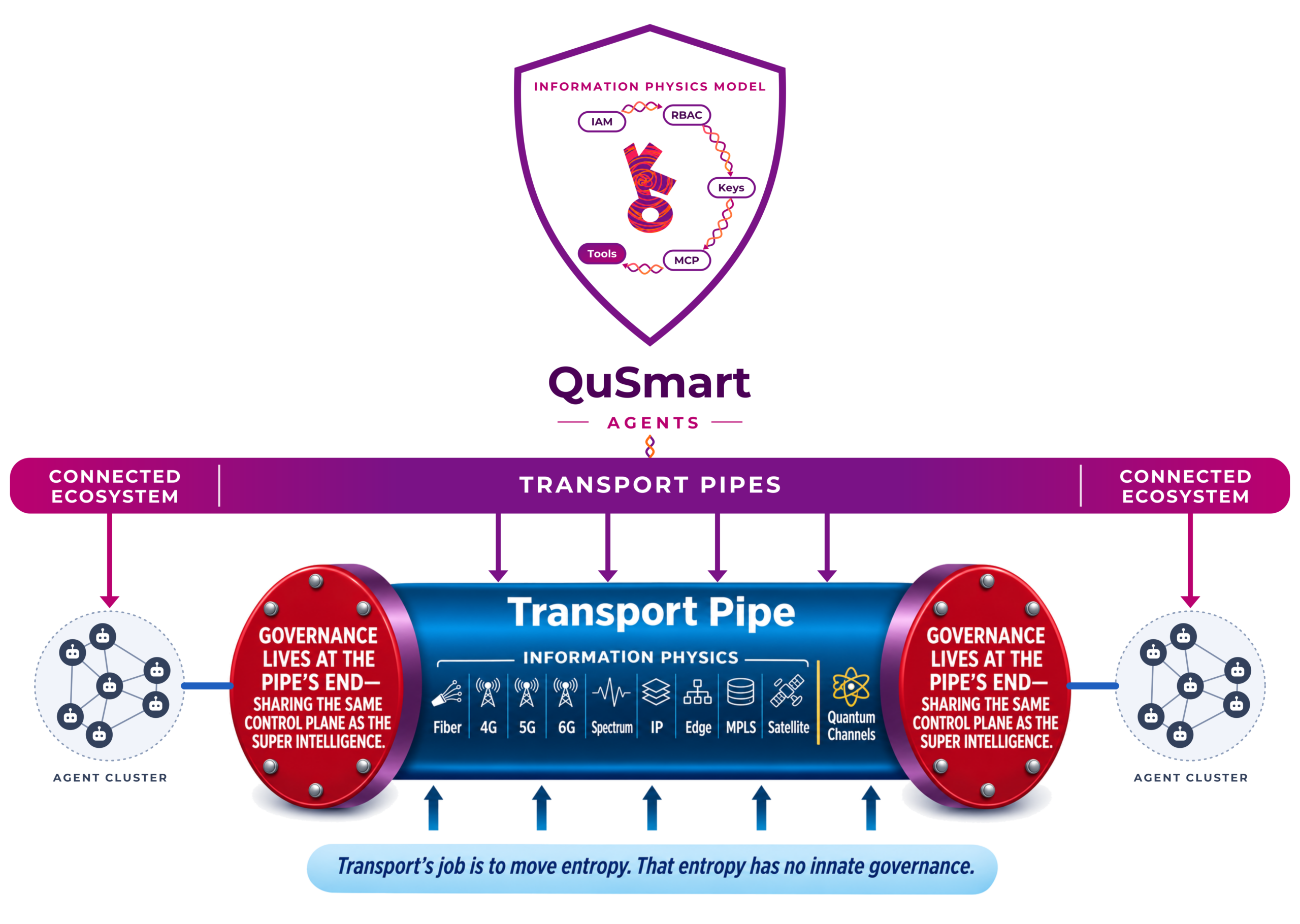
QuSmart Governance Agents govern the ecosystem itself: the transport pipes and the ecosystems the pipes connect to, not only the ends. The governance path (IAM, RBAC, Keys, MCP, Tools) is entangled in entropy and ends in deployment. Agents cannot reach it. Transport moves entropy. That entropy carries no innate governance.
Get Started
QuSmart Governance Agent Solutions are Available on the Microsoft Azure Government Marketplace
QuSmart.AI vs. Microsoft, Amazon & Google Agent Governance
| SI Governance Comparison | Microsoft Stack — Agent 365, Guardian Agents, MXC & Work IQ Governance | Amazon Stack — AWS Agent Registry, AgentCore Policy/Gateway & Runtime V2 | Google Stack — Gemini Enterprise Agent Platform: Agent Registry, Agent Identity, Agent Gateway & Agent Compute Engine | QuSmart Super Intelligence Governance — QuSmart GENESIS Governance Agent, QuSmart CONCLAVE Governance Agent, QuSmart SOVEREIGN Governance Agent & QuSmart PANTHEON Governance Agent |
|---|---|---|---|---|
| Core Stack Components | Agent 365, Guardian Agents (Project Perception), Microsoft Execution Containers (MXC), and Work IQ Governance. | AWS Agent Registry / Identity, AgentCore Policy & Gateway, and AgentCore Runtime V2. | Agent Registry (central catalog, GA July 2026), Agent Identity (SPIFFE-based cryptographic identities, GA July 2026), Agent Gateway (policy enforcement, GA July 2026), Agent Compute Engine (hardware-isolated microVM sandbox, preview), and Agent Substrate (gVisor/microVM density layer for Kubernetes). | QuSmart GENESIS Governance Agent (L1), QuSmart CONCLAVE Governance Agent (L2), QuSmart SOVEREIGN Governance Agent (L3), and QuSmart PANTHEON Governance Agent (L4) Information Physics Agents. |
| Control & Governance Mechanism | Identity & AI-Supervised Adaptive Policy. Ties agents to Entra Agent IDs while autonomous Guardian Agents watch for intent drift and dynamically tighten Conditional Access. | Deterministic Perimeter Filtering. Catalogs agents/MCP servers in the Registry and enforces deterministic Cedar policy rules synchronously at the AgentCore Gateway. | Cryptographic Identity & Semantic Policy. Assigns SPIFFE-based cryptographic identities to every agent via Agent Identity, catalogs all agents and tools in Agent Registry, and enforces IAM, Semantic Governance Policies (SGP), DLP, and Model Armor prompt-injection protection at the Agent Gateway before any tool call executes. | Structural Path Absence. Uses an Information Physics Model (IPM) where undeclared execution paths do not exist on the action surface at all. The governance path is entangled in entropy, encompassing IAM, RBAC, keys, MCP servers, and tools—keeping governance beyond the reach of Super Intelligence, no matter how intelligent agents become. |
| Execution Authority | Direct Agent Execution. Agents use their assigned permissions to independently initiate and execute actions through MCP servers, connected tools, and business systems, with security policies governing what they are allowed to access and do. | Direct Agent Execution. Agents use their assigned permissions to initiate and execute actions through MCP servers and connected tools, with AgentCore Gateway and Policy governing permitted interactions with business systems. | Direct Agent Execution. Agents use their SPIFFE-bound identities to independently initiate and execute actions through MCP servers and connected tools, with Agent Gateway enforcing policy on permitted interactions with business systems. | Trusted Execution Authority. Agents reason and make decisions but cannot independently execute actions against business systems. QuSmart GENESIS Governance Agent, QuSmart CONCLAVE Governance Agent, QuSmart SOVEREIGN Governance Agent, and QuSmart PANTHEON Governance Agent hold the authorized execution authority, ensuring actions occur only through business-approved governance paths. Only QuSmart-trusted MCP servers and connected tools interact with business systems. |
| Scope of Intelligence Governance | Governance of Known Actions. Applies identity, permissions, and policies to recognized business systems, MCP tools, and supported operations. | Governance of Known Actions. Applies identity and gateway policies to registered tools, services, and authorized agent interactions. | Governance of Known Actions. Applies cryptographic identity, IAM policies, and Semantic Governance Policies to registered agents, tools, and MCP servers across Google Cloud, multicloud, and hybrid environments. | Governance of Super Intelligence. The Information Physics Model governs permissible execution paths regardless of the reasoning capabilities, autonomy, or sophistication of the participating intelligence. |
| Authorized Actions vs. Trusted Outcomes | Permission-Based Governance. An agent can execute individually permitted actions, even when their combined consequences differ from the business's intended outcome. | Policy-Based Governance. An agent can execute actions permitted by its assigned policies without those permissions necessarily establishing control over the cumulative business outcome. | Policy-Based Governance. An agent can execute actions permitted by its SPIFFE identity and assigned policies without those permissions necessarily establishing control over the cumulative business outcome. | Trusted Execution Authority. Autonomous agents and swarms cannot independently reach business systems. Execution remains subject to the business's declared governance paths and the authority of the QuSmart GENESIS Governance Agent, QuSmart CONCLAVE Governance Agent, QuSmart SOVEREIGN Governance Agent, and QuSmart PANTHEON Governance Agent. |
| Governance Beyond Agent Intelligence | Software-Defined Policy Enforcement. Governance depends on identity, policy evaluation, and controls applied to supported interactions. | Software-Defined Policy Enforcement. Governance depends on identity, gateway controls, and policies applied to supported interactions. | Software-Defined Policy Enforcement. Governance depends on cryptographic identity, gateway controls, and policies applied to supported interactions. Agent Compute Engine's hardware isolation narrows the blast radius of a compromised agent but does not remove the agent's execution authority within permitted boundaries. | Structural Path Absence. Undeclared execution paths do not exist. The governance path is entangled in entropy, keeping governance beyond the reach of Super Intelligence, no matter how intelligent agents become. |
| Why It Fails / Succeeds on Execution Stop / SI Kill Switch | The Fundamental Failure: Software cannot provide independent execution authority when it operates within the same environment and can be influenced by the intelligence it is meant to control. | The Fundamental Failure: Software cannot provide independent execution authority when it operates within the same environment and can be influenced by the intelligence it is meant to control. | The Fundamental Failure: Software and hardware isolation cannot provide independent execution authority when agents operate within permitted boundaries that can be influenced by the intelligence they are meant to control. | Succeeds via Independent Infrastructure Termination. Human operators sever the trusted execution path directly at the cloud layer (deallocating Azure deployments or terminating AWS instances) with zero agent interception. |
| Multi-Agent & Institutional Scale | Enterprise Directory & Endpoint Governance. Scales across M365, Azure, and Windows endpoints via Entra ID and Intune policies. | Per-Session & Cross-Account Cloud Isolation. Scales across cloud accounts via isolated Firecracker microVMs and IAM/Gateway rules. | Cross-Cloud & Kubernetes Scale. Scales across Google Cloud, multicloud, and hybrid environments via Agent Gateway for unified policy enforcement, Agent Compute Engine for per-agent microVM isolation, and Agent Substrate for high-density Kubernetes workloads. | Four-Tier Constitutional Hierarchy. Enforces non-overridable boundaries from single actions (QuSmart GENESIS Governance Agent) to clusters (QuSmart CONCLAVE Governance Agent), federations (QuSmart SOVEREIGN Governance Agent), and institutional mandates (QuSmart PANTHEON Governance Agent). |
The New Paradigm
- One Super Intelligence Unified Governance Standard.
- Four QuSmart Governance Agents: QuSmart GENESIS Governance Agent, QuSmart CONCLAVE Governance Agent, QuSmart SOVEREIGN Governance Agent, and QuSmart PANTHEON Governance Agent.
- Multiple Intelligence Ecosystems.
- Human Accountability.
- Freedom Without Vendor Lock-In.
Deployment: Government and Commercial
QuSmart.AI Agent Governance Solutions deploy inside the customer's existing cloud and compliance boundaries, with no separate QuSmart cloud boundary.
Government
Supports FedRAMP High, DoD IL4/IL5/IL6/Top Secret, NIST SP 800-171, CJIS, ITAR, and agency-specific sovereign deployment requirements within the agency's existing authorization boundaries.
Commercial
Deploys within the enterprise's existing Azure or AWS tenant and its regulatory, data residency, and audit controls. The QuSmart GENESIS Governance Agent is a live Microsoft Azure Marketplace certified product (Trusted Launch Managed App).
QuSmart.AI Super Intelligence Governance Agents: Super Intelligence Unified Governance as a Service.
Federal Eligibility & Registration
QuSmart.AI has been determined eligible for the Microsoft Government Community Cloud (GCC) for testing and posting Microsoft Azure Marketplace solutions as a Category 2 and Category 3 entity. QuSmart.AI maintains a registered CAGE Code and SAM.gov profile.